



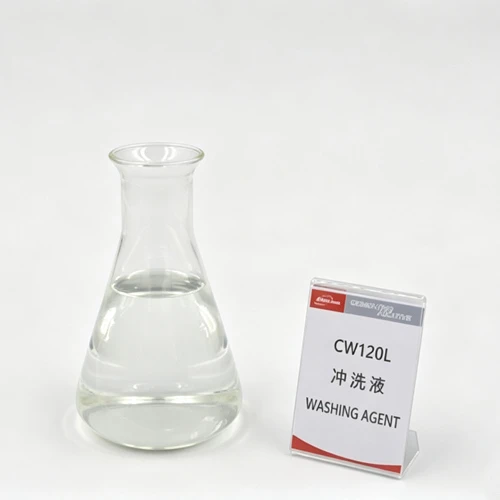
Tianjin Kelioil Engineering Material and Technology Co., Ltd. is one of the leading manufacturers and suppliers of cw120l non-phosphorus cementing spacer washing liquid in China. Please feel free to buy high quality cw120l non-phosphorus cementing spacer washing liquid at low price from our factory. If you have any enquiry about free sample, please feel free to email us.
Advanced Oil-Based Mud Scour Agent & Interfacial Wettability Modifier for Superior HPHT Zonal Isolation
1.1 Executive Summary and Engineering Overview
In high-pressure, high-temperature (HPHT) primary cementing operations, achieving complete mud displacement and ensuring permanent zonal isolation remain critical engineering challenges. Inadequate removal of drilling fluid, particularly synthetic-based mud (SBM) or oil-based mud (OBM), leaves persistent mud cakes and hydrophobic organic films along the casing pipe and formation surfaces. These residual oil layers prevent direct bonding between the hydrated cement slurry and the substrate, resulting in micro-annular gas migration channels, fluid cross-flow behind the pipe, premature casing corrosion, and costly remedial squeeze cementing jobs.
CW120L Non-Phosphorus Washing Liquid is an environmentally engineered, high-performance aqueous flushing agent designed specifically to address interfacial bonding failure in oilfield cementing applications. Operating reliably at bottomhole circulating temperatures (BHCT) up to 180°C (356°F), CW120L provides aggressive detergent, emulsification, and stripping capabilities. It penetrates dense mud cakes, breaks up oil-wet polymer matrices, emulsifies hydrocarbons, and rapidly transforms the wettability of casing steel and rock formations from oil-wet to strongly water-wet.
By establishing a clean, hydrophilic surface prior to the arrival of the lead cement slurry, CW120L maximizes both First Interface (casing-to-cement) and Second Interface (cement-to-formation) shear and hydraulic bond strengths. Furthermore, its advanced non-phosphorus formulation complies fully with modern environmental discharge standards, making it an ideal choice for ecologically sensitive onshore fields and offshore deepwater operations.
2. Technical Core: Surfactant Micellar Penetration and Interfacial Stripping Mechanism
2.1 Molecular Wetting Reversal and Interfacial Tension Reduction
Oil-based drilling fluids utilize lipophilic surfactants to maintain emulsion stability and keep formation surfaces oil-wet. When cementing across these zones, conventional water flushes fail because the high interfacial tension between water and the oil film prevents intimate contact. CW120L solves this fundamental physical barrier through a synergistic blend of specialized non-ionic and anionic surfactant head-groups. Upon introduction into the wellbore annulus, CW120L drastically reduces the interfacial tension at the oil-water contact zone.
The surfactant molecules migrate rapidly to the casing and formation interfaces, aligning their hydrophobic tails toward the oil film and their hydrophilic heads toward the bulk aqueous stream. This alignment induces a swift wetting reversal, converting hydrophobic oil-wet surfaces into hydrophilic water-wet states within minutes. Once water-wettability is restored, the hydrated cement slurry can directly contact, hydrate against, and mechanically interlock with the steel casing and exposed rock matrix.
2.2 Solubilization, Emulsification, and Micro-Suspension Dynamics
Beyond surface wetting reversal, CW120L Non-Phosphorus Washing Liquid dynamically disrupts the structural integrity of sticky mud cakes through solubilization and micro-emulsification. The active surfactant micelles penetrate deep into the dense bitumen, wax, and organophilic clay network of the mud cake. As the micelles solubilize the hydrocarbon binder, the structural cohesion of the mud cake deteriorates rapidly.
Under turbulent or high-shear laminar flow conditions in the annulus, CW120L encapsulates the detached oil droplets and barite solids into stable, fine-emulsion droplets. These micro-emulsion aggregates remain suspended in the wash solution, preventing re-deposition onto the newly cleaned casing walls. The suspended mud debris is then seamlessly displaced out of the wellbore annulus ahead of the main cement train.
2.3 Environmental Non-Phosphorus Chelating Synergism
Traditional industrial cleaning agents often rely heavily on phosphate-based builders to sequester divalent metal ions. However, phosphate discharge is strictly regulated or prohibited in offshore marine environments and environmentally sensitive land basins due to eutrophication risks. CW120L eliminates all phosphorus components while maintaining superior cleaning performance through an advanced organic chelating system.
This proprietary non-phosphorus complexing matrix effectively binds calcium (Ca²⁺) and magnesium (Mg²⁺) ions present in formation water or residual drilling fluids. By preventing hard-water ions from precipitating active surfactant species, CW120L maintains maximum surfactant activity, optimal micelle formation, and consistent cleaning efficiency across wide temperature and salinity profiles downhole.
3. Key Product Features and Practical Commercial Benefits
- 🌱 Fully Non-Phosphorus Eco-Friendly Formulation: Satisfies strict environmental compliance regulations for marine discharge and sensitive onshore environments without compromising washing efficiency.
- 🔥 Exceptional HPHT Thermal Stability: Maintains active chemical detergency and molecular integrity at elevated bottomhole circulating temperatures up to 180°C (356°F).
- 🛡️ Maximizes Interfacial Bond Quality: Eliminates micro-annular gas leaks and fluid migration channels by restoring strongly water-wet surfaces on both casing steel and formation rock.
- 💧 Flexible Field Dosing and Dilution: Effective as a concentrated stock solution or diluted 3 to 5 times with clean fresh water, significantly optimizing logistics and chemical treatment costs.
- 🔄 Rapid Mud Cake Stripping Speed: Achieves complete detergent penetration, oil emulsification, and mud cake peeling within short contact time windows during spacer pumping.
- ⚡ Optimizes Cement Bond Logs (CBL/VDL): Promotes high acoustic amplitude attenuation and tight cement bond evaluation logs across critical hydrocarbon production zones.
- 🛡️ Corrosion Prevention Support: By removing acid-gas trapping mud residues from the casing surface, it minimizes localized under-deposit casing corrosion over the life of the well.
- 🏭 Universal Application Versatility: Highly effective across vertical, directional, extended-reach (ERD), and horizontal well geometries using synthetic, mineral, or diesel-based drilling fluids.
4. Physical, Chemical, and Slurry Performance Indicators
4.1 Physical and Chemical Properties Table
| Technical Indicator / Property | Standard Target Requirement | Typical Laboratory Verified Value |
|---|---|---|
| Appearance | Colorless liquid | Colorless, transparent liquid |
| Density (g/cm³) | 1.00 ± 0.05 | 1.01 |
| Water Solubility | Soluble | Completely Soluble |
| Maximum Operational Temperature (BHCT) | ≤ 180°C (356°F) | 180°C (356°F) |
| Casing Surface Washing Efficiency (10 min, %) | ≥ 60 | 72.5 |
| Phosphorus Content (%) | 0.00 (Phosphorus-free) | 0.00 |
| pH Value (25°C) | 6.5 – 8.5 | 7.2 |
4.2 Slurry and Performance Evaluation
The mud cake removal and casing cleaning efficiency of CW120L Non-Phosphorus Washing Liquid are rigorously evaluated in laboratory conditions to ensure full compliance with oilfield cementing standard requirements.
Standard Laboratory Test Method and Protocol: Measure the cleaning efficiency using a customized rotational viscometer assembly. Prepare a standard steel casing rotor sleeve treated with crude oil and active oil-based drilling mud to simulate an oil-wet wellbore casing surface (remove the internal vats from the fan viscometer assembly). Fill the test cup with a freshly prepared CW120L washing solution maintained at a constant fluid temperature of ≥ 38°C. Submerge the oil-treated rotor sleeve into the wash solution and operate the fan viscometer at a constant rotational speed of 300 r/min for exactly 10 minutes. Upon completion of the 10-minute shear cycle, carefully remove the rotor, rinse gently with deionized water, dry to constant weight, and gravimetrically calculate the percentage of mud cake removed. The cleaning efficiency must equal or exceed the technical threshold of 60%.
5. Field Application Recipes and Strict Operational Criteria
5.1 Standard Recipe / Formulation
CW120L can be formulated into various spacer configurations depending on well depth, mud cake thickness, shear rates, and available volume constraints:
- Concentrated Treatment (Stock Solution): Pumped as pure, undiluted CW120L stock liquid in critical HPHT intervals, horizontal open-hole completions, or heavy SBM environments requiring maximum detergent velocity.
- Standard Field Dilution Ratio: Dilute 1 volume unit of CW120L with 3 to 5 volume units of clean fresh water (yielding a 20% to 25% active solution concentration by volume).
- Volumetric Spacer Sizing: Field pumping volumes should be calculated to ensure a minimum fluid contact time of 8 to 10 minutes across the open-hole target zone under actual displacement pumping rates.
5.2 Critical Mixing Constraints & Incompatibility Mandates
CRITICAL WARNING: CW120L MUST NOT be prepared or mixed using batch water that contains high concentrations of inorganic salts, unconsumed polymer additives, heavy brines, or active chemical contaminants. Applying CW120L in combination with contaminated or high-salinity mixing water induces severe surfactant phase separation, rapid chemical precipitation, complete loss of surface-active cleaning performance, and severe downhole fluid incompatibility. Mixing water must be tested and verified as clean fresh water prior to CW120L addition.
5.3 Pre-Operational Compatibility Testing
To ensure flawless downhole execution, comprehensive compatibility testing must be conducted in the field laboratory prior to pumping. Field engineers must mix the prepared CW120L washing fluid with the active drilling mud and the designated lead cement slurry at volumetric ratios of 95:5, 75:25, 50:50, 25:75, and 5:95. Viscosity, yield point, and gel strength development must be measured across all blend ratios to verify that no severe fluid thickening, flash setting, or immovable gel structures form at fluid interfaces during displacement.
6. Commercial Packaging, Shelf Life, and Storage Characteristics
6.1 Normal Storage Appearance Phenomenon
When stored for extended periods under cold or fluctuating ambient storage conditions, CW120L may occasionally exhibit slight cloudiness, mild turbidity, or minor phase stratification. This visual change is a completely normal physical surfactant phase equilibrium behavior resulting from temperature-induced solubility shifts in high-concentration surfactant blends. Simple mechanical stirring, drum rolling, or fluid recirculation prior to mixing fully restores the product to a clear, homogeneous state. This temporary visual condition has absolutely zero adverse effect on chemical performance, downhole detergent efficiency, or casing washing potency.
6.2 Expiration and Re-testing Policies
The standard shelf life for CW120L is 12 months from the date of manufacture when kept in its original, unopened, and undamaged containers within temperature-controlled storage facilities. Once the 12-month period has elapsed, the product lot must undergo quality assurance re-testing prior to field use. Re-certification requires verifying density (1.00 ± 0.05 g/cm³), solubility, and confirming that the 10-minute casing surface washing efficiency remains at or above the 60% requirement.
6.3 Standard Industrial Packaging Configurations
- 25 kg Heavy-Duty Plastic Drums / Jerry Cans
- 200 L Standard HDPE Industrial Drums
- 5 US Gallon Heavy-Duty Plastic Pails
- 1000 L Intermediate Bulk Container (IBC) Totes and custom bulk packaging upon request
7. Frequently Asked Questions (FAQ) for Engineering Teams
- Q1: Can CW120L be diluted using produced water or high-salinity field water?
- A1: No. CW120L must be diluted strictly with clean fresh water. Utilizing high-salinity water, produced water, or sea water causes severe surfactant precipitation, destroying the emulsification mechanism and drastically reducing cleaning efficiency.
- Q2: How does CW120L contribute to better Cement Bond Log (CBL) quality?
- A2: By stripping the non-conductive oil film and mud cake from the steel casing and formation faces, CW120L allows direct cement-to-steel hydration. This eliminates micro-annular gaps, resulting in high acoustic signal attenuation and clear, high-bonding CBL/VDL logs.
- Q3: What action should field crews take if CW120L shows minor layering inside the drum?
- A3: Layering or turbidity after prolonged storage is a normal physical property of concentrated surfactant mixtures. The field crew should stir, roll, or circulate the drum to homogenize the liquid before pumping. Testing confirms that chemical activity remains 100% intact.
8. Contact Kelioil for Professional Cementing Solutions
Achieve flawless wellbore cleanout and ensure durable, lifetime zonal isolation on your next drilling project. Contact the technical engineering team at Kelioil today to request product samples, schedule custom compatibility testing, or request a commercial quote for CW120L Non-Phosphorus Washing Liquid.
Hot Tags: cw120l non-phosphorus cementing spacer washing liquid, China cw120l non-phosphorus cementing spacer washing liquid manufacturers, suppliers, factory, cementing performance enhancer, industrial cementing additive, non toxic cementing additive, premium cementing additive, professional cementing additive, well cementing additive


