



Foam formation in oil well cementing is more than just a minor inconvenience - it can lead to serious technical and safety issues. Excessive foam in cement slurries affects density, increases compressibility, and causes inaccurate mixing ratios. That's why cementing defoamers are an essential part of modern well cementing operations.

What Is a Cementing Defoamer?
A cementing defoamer is a specialized chemical additive designed to remove or prevent foam in cement slurries during the mixing and pumping process.
When cement, water, and various additives (such as dispersants or surfactants) are mixed at high speed, air can easily be trapped, forming stable bubbles. If these bubbles remain, they can:
Lower the slurry density and create inaccurate cement volumes.
Reduce compressive strength of the set cement.
Cause irregular pressure during pumping and placement.
A good cementing defoamer must not only eliminate foam quickly but also remain stable under high temperature and pressure conditions, without negatively affecting other properties of the cement slurry.
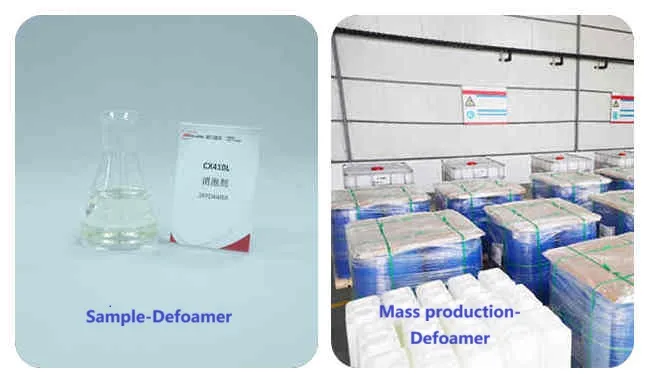
How Cementing Defoamers Work
Defoamers function primarily through three mechanisms:
- Spreading and film breaking – The defoamer spreads over foam films and destabilizes them, causing bubbles to collapse.
- Gas diffusion – It promotes the escape of trapped air from the slurry to the surface.
- Surface tension reduction – It reduces surface energy differences, preventing new foam formation. Effective defoamers have low surface tension, are poorly soluble in water, and remain thermally stable across wide temperature ranges.
Types of Cementing Defoamers
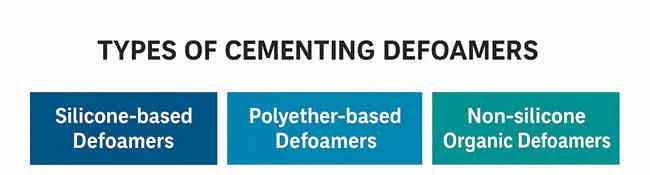
Cementing defoamers are typically divided into three categories:
- Silicone-based defoamers
Very strong and long-lasting defoaming effect.
Suitable for high-temperature applications.
May cause compatibility issues in some systems if not properly formulated.
- Polyether-based defoamers
Good balance between defoaming efficiency and system compatibility.
Widely used in standard cementing operations.
- Non-silicone organic defoamers
Environmentally friendly and easy to disperse.
Commonly used when silicone contamination must be avoided.
Each formulation type has its own advantages, and selection depends on cement composition, temperature, salinity, and field conditions.
Performance Requirements in Oilfield Cementing
For oil well cementing, defoamers must meet stricter standards than ordinary industrial antifoams.
They need to:
Remain stable under 150–180°C or even higher downhole conditions.
Be compatible with other cementing additives such as fluid loss control agents, dispersants, retarders, and gas migration control additives.
Work effectively in both freshwater and saltwater systems.
Have low dosage requirements (typically 0.1–0.5% BWOC).
Maintain slurry density and flow properties.
In deep wells and high-pressure formations, these characteristics directly influence the reliability of cement placement and the long-term sealing performance of the well.
Applications in Field Operations
During cement slurry preparation, the defoamer is typically added either directly into the mix water or during slurry blending.
Its presence ensures:
Smooth pumping with minimal air entrainment.
Accurate density control and consistent rheology.
Improved compressive strength of the final cement sheath.
In offshore and HPHT (High Pressure High Temperature) wells, effective defoaming is even more critical due to aggressive mixing conditions and the need for precise slurry properties.

Reliable Supply from China
In China, KELIOIL GROUP (Tianjin) is one of the professional manufacturers of oilfield cementing additives, including high-performance cementing defoamers.
With large-scale production facilities and automated processes, KELIOIL helps global customers reduce procurement costs while ensuring consistent quality that meets international standards.

Conclusion
Foam control is a key factor in achieving safe, strong, and efficient cementing results. The right cementing defoamer ensures stable slurry density, reliable set cement properties, and reduced operation risks.
By understanding how defoamers work and selecting the proper formulation for each field condition, oilfield operators can significantly improve the quality and performance of their cementing operations - and lower overall project costs.


