
For any professional cement testing laboratory, selecting the right Atmospheric Consistometer is not just a purchasing decision. It is a long-term investment that directly impacts testing accuracy, repeatability, research efficiency, and even customer trust. Cement slurry thickening time results are widely used for slurry design optimization, additive evaluation, and field cementing decision support. If the Atmospheric Consistometer provides unstable curves or inconsistent results, laboratory data becomes unreliable and costly mistakes may happen.
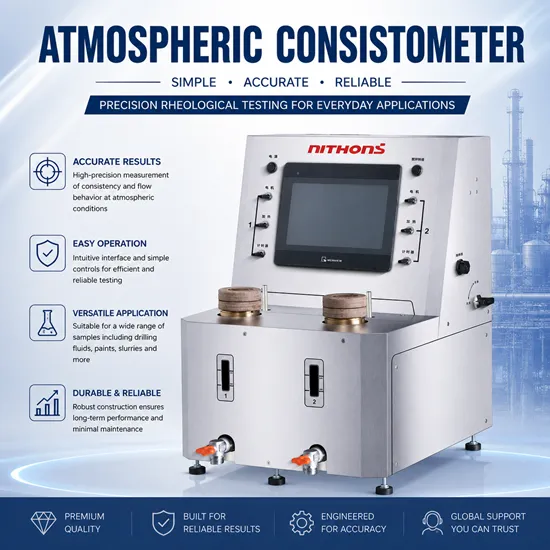
Among many models available on the market, the NCCQ2220 Dual-Cell Atmospheric Consistometer stands out as one of the most practical and professional choices for cement laboratories. It is designed to provide stable performance, accurate torque-based consistency measurement, reliable temperature control, and high-efficiency dual-cell testing capability.
In this article, we will explain why the NCCQ2220 is widely considered an excellent option, what makes dual-cell design valuable, what key specifications matter in an Atmospheric Consistometer, and how cement labs can benefit from selecting this model for daily operations and long-term R&D work.
1. What Is an Atmospheric Consistometer and Why Do Cement Laboratories Need It?
An Atmospheric Consistometer is a laboratory instrument used to measure cement slurry consistency development under atmospheric pressure conditions. It is one of the most widely used cement testing instruments in oilfield cementing laboratories because it provides reliable thickening trend evaluation for slurry formulation development.
The working principle of an Atmospheric Consistometer is based on torque resistance. A slurry cup holds cement slurry, while a paddle rotates at a constant speed. As hydration progresses, slurry thickens, resistance increases, and the instrument records torque changes. The system converts this torque into a consistency curve, typically expressed in Bearden units of consistency (Bc).
Cement laboratories use an Atmospheric Consistometer for many reasons, including:
- Thickening time screening tests for cement slurry design
- Performance comparison of cement additives such as retarders, dispersants, and fluid loss additives
- Quality control testing of additive batches
- Laboratory training for cementing engineers and technicians
- Preliminary slurry formulation screening before HTHP consistometer testing
- Research on hydration behavior and slurry stability under controlled temperature conditions
Even though downhole cementing operations require high pressure simulation, the Atmospheric Consistometer remains a necessary tool for daily cement testing. It is often the first step in slurry formulation development because it provides fast, cost-effective, and repeatable evaluation results.
Therefore, selecting a reliable Atmospheric Consistometer is essential for any cement lab that wants stable and professional testing performance.
2. Why Is Dual-Cell Design Important in an Atmospheric Consistometer?
When cement laboratories choose an Atmospheric Consistometer, one of the most valuable design upgrades is the dual-cell configuration. A dual-cell Atmospheric Consistometer means the instrument can test two slurry samples at the same time, under the same temperature conditions and controlled rotation speed.
The dual-cell advantage is especially important because cement labs often need to compare slurry systems side by side. For example, a lab may test:
- Base cement slurry vs slurry with retarder
- Standard additive dosage vs higher dosage
- Different fluid loss additives performance comparison
- Different dispersant types comparison
- Different cement types or cement blends comparison
- Two different water-to-cement ratios comparison
If a lab uses a single-cell Atmospheric Consistometer, these comparisons must be performed one by one. This consumes more time, requires repeated heating cycles, and increases testing workload.
A dual-cell Atmospheric Consistometer like the NCCQ2220 allows laboratories to run two tests simultaneously. This provides three major benefits:
Higher laboratory efficiency
Testing time is reduced because two samples are evaluated at once.
Better comparison accuracy
Two samples are tested under identical environmental conditions, improving comparison reliability.
Reduced operator workload
Technicians can complete more tests per day with less manual repetition.
This is why the dual-cell design is a major reason why the NCCQ2220 is a preferred Atmospheric Consistometer for professional cement laboratories.
3. What Makes the NCCQ2220 Dual-Cell Atmospheric Consistometer Special?
The NCCQ2220 Dual-Cell Atmospheric Consistometer is designed specifically for cement slurry consistency evaluation. It is not a generic lab mixer or a modified rheology device. It is built to meet the practical demands of cementing laboratories that require stable testing results, smooth consistency curves, and long-term mechanical durability.
Key features that make the NCCQ2220 a strong choice include:
- Dual-cell configuration for high-efficiency testing
- Reliable temperature control system for stable heating conditions
- Stable motor rotation and torque measurement system
- Stainless steel industrial structure suitable for cement slurry environment
- User-friendly operation interface for laboratory technicians
- High repeatability performance for additive evaluation and QC testing
In real cement testing work, the best Atmospheric Consistometer is not defined by one single parameter. It is defined by the overall balance between accuracy, repeatability, durability, and usability. The NCCQ2220 is designed to provide that balance, which is why it is considered one of the best Atmospheric Consistometer choices for cement laboratories.
4. How Does NCCQ2220 Improve Atmospheric Consistometer Testing Efficiency?
Efficiency is a critical factor in cement laboratories. Many labs must handle daily workloads including customer testing requests, internal R&D evaluation, and routine QC verification. A laboratory instrument must support this workload without creating bottlenecks.
The NCCQ2220 improves Atmospheric Consistometer testing efficiency mainly through its dual-cell design. This means two slurry cups can be tested simultaneously. For labs that run multiple thickening time screening tests per day, this design can double testing capacity without increasing equipment footprint.
Efficiency improvements include:
- Reduced total testing time per project
- Faster additive evaluation cycles
- More test data generated per day
- Reduced heating and cooling waiting time
- Reduced labor cost and technician workload
Another advantage is that dual-cell testing reduces environmental variation. When two samples are tested separately, slight differences in temperature ramp, ambient room temperature, or slurry preparation timing may influence results. With NCCQ2220 dual-cell testing, both samples are tested under the same conditions, improving comparison accuracy and reducing uncertainty in Atmospheric Consistometer results.
For cement additive manufacturers, this is extremely valuable because it supports faster formulation optimization and quicker product development cycles.
5. Why Is Temperature Control Critical in an Atmospheric Consistometer?
Temperature control is one of the most important performance indicators of an Atmospheric Consistometer. Cement hydration speed is strongly temperature dependent. Even a small temperature deviation can cause thickening time results to shift significantly, especially when testing retarded cement systems.
A professional Atmospheric Consistometer must provide stable temperature control, not only reaching the target temperature but also maintaining it for long test durations. Cement thickening time tests can last several hours depending on slurry design. During this time, temperature fluctuation can cause curve instability and inaccurate thickening point determination.
The NCCQ2220 Dual-Cell Atmospheric Consistometer is designed to provide stable heating conditions that support repeatable testing results. This is essential for cement laboratories performing comparative additive testing, because consistent temperature control ensures the consistency curve reflects slurry chemistry rather than equipment variation.
When evaluating temperature control quality in an Atmospheric Consistometer, laboratories should focus on:
- Temperature accuracy
- Temperature stability during long tests
- Heating response speed
- Temperature uniformity inside the chamber
- Overheat protection and safety control
A well-designed heating system is a key reason why NCCQ2220 is considered a reliable Atmospheric Consistometer for cement testing laboratories.
6. How Does NCCQ2220 Ensure Stable Torque and Consistency Measurement?
The torque measurement system is the core of any Atmospheric Consistometer. Cement slurry consistency curves depend on torque feedback from paddle resistance. If torque signals are unstable, the Bc curve will fluctuate, and thickening time determination becomes unreliable.
A stable Atmospheric Consistometer must have a high-quality torque sensor system, stable signal processing, and a smooth mechanical transmission system. Poor mechanical vibration or unstable motor speed will directly influence torque readings.
The NCCQ2220 is designed with a stable motor system and reliable torque feedback mechanism, supporting smooth curve generation. This is particularly important for testing cement systems with strong gel strength development, where torque changes may occur rapidly. A professional Atmospheric Consistometer must accurately capture these changes without producing noise or false spikes.
Stable torque measurement ensures that NCCQ2220 can provide:
- Smooth and continuous consistency curves
- Clear thickening time determination points
- Reliable comparison between two test cells
- Better repeatability for QC testing
For cement laboratories, this means fewer test failures and more confidence in slurry performance evaluation using the Atmospheric Consistometer.
7. How Does NCCQ2220 Improve Repeatability in Atmospheric Consistometer Testing?
Repeatability is the most important factor when selecting the best Atmospheric Consistometer. A cement lab must be able to run the same slurry formulation multiple times and obtain consistent thickening time results. If repeatability is poor, additive performance evaluation becomes meaningless.
The NCCQ2220 improves Atmospheric Consistometer repeatability through several design factors:
Dual-cell identical environment testing
Two samples are tested under the same temperature and rotation conditions, reducing environmental differences.
Stable mechanical transmission
A well-designed structure reduces vibration, ensuring stable torque measurement.
Reliable temperature control system
Stable heating reduces curve deviation caused by temperature fluctuation.
Consistent slurry cup and paddle system
High-quality stainless steel slurry cups and accurate paddle design ensure uniform slurry circulation inside the Atmospheric Consistometer.
In cement additive development, repeatability is essential for comparing different formulations. With NCCQ2220, laboratories can generate repeatable results, allowing engineers to confidently evaluate retarder dosage, dispersant performance, or fluid loss additive efficiency based on Atmospheric Consistometer test curves.
8. What Types of Cement Slurry Tests Can Be Done with NCCQ2220 Atmospheric Consistometer?
The NCCQ2220 Dual-Cell Atmospheric Consistometer is suitable for a wide range of cement slurry testing tasks. It can support routine QC testing as well as advanced R&D evaluation. Many cement labs use an Atmospheric Consistometer daily, so versatility is important.
Common tests performed with NCCQ2220 include:
- Cement thickening time screening at atmospheric pressure
- Additive compatibility evaluation tests
- Retarder performance comparison tests
- Dispersant dosage optimization tests
- Fluid loss additive influence screening
- Anti-gas migration additive thickening behavior evaluation
- Slurry stability evaluation based on curve behavior
- Cement blend formulation comparison tests
- Lightweight cement system preliminary screening tests
The dual-cell design makes NCCQ2220 especially effective for comparative testing. Engineers can run base slurry in one cell and modified slurry in the other cell, making the Atmospheric Consistometer test results more meaningful and efficient.
This is one of the main reasons NCCQ2220 is widely considered a practical Atmospheric Consistometer for cement laboratories with heavy testing workload.
9. Why Is Stainless Steel Structure Important for an Atmospheric Consistometer?
Cement slurry is chemically aggressive and can cause corrosion if equipment materials are not suitable. Many cement systems contain salt, dispersants, retarders, and other chemicals that may accelerate corrosion of low-grade metal components.
A professional Atmospheric Consistometer should use stainless steel structure, especially for components exposed to slurry or cleaning water. Stainless steel provides corrosion resistance, durability, and easier cleaning, making it ideal for long-term laboratory operation.
The NCCQ2220 Atmospheric Consistometer uses an industrial stainless steel design that supports long service life. This is important because cement laboratories often run continuous tests, and frequent cleaning is required. Stainless steel surfaces reduce cement adhesion and make cleaning more efficient.
Advantages of stainless steel design in an Atmospheric Consistometer include:
- Better corrosion resistance
- Longer equipment lifespan
- Easier cleaning after cement slurry testing
- Improved laboratory safety and hygiene
- Better structural stability during heating cycles
For laboratories that test salt-resistant cement systems or aggressive additives, stainless steel design is a critical requirement when selecting the best Atmospheric Consistometer.
10. What Data Display and Control Features Should a Modern Atmospheric Consistometer Have?
Modern cement laboratories require more than basic curve display. Data recording, export, and user-friendly control interfaces are increasingly important. A modern Atmospheric Consistometer should allow technicians to easily operate the instrument and save test results for future analysis.
Important control and data features include:
- Touchscreen interface for easy parameter setting
- Real-time curve display for monitoring test progress
- Digital temperature and consistency value display
- Automatic data storage for test history management
- USB export function for curve analysis and reporting
- Alarm function for abnormal conditions
- User-friendly menu design to reduce operator mistakes
The NCCQ2220 Dual-Cell Atmospheric Consistometer is designed with a modern operation interface that supports efficient laboratory work. For cement additive suppliers, the ability to export curves and provide reports is valuable for customer communication and product qualification.
A modern data system reduces manual recording workload and improves QC traceability. This is why data control features should always be evaluated when selecting the best Atmospheric Consistometer.
11. What Maintenance Advantages Does NCCQ2220 Provide for Atmospheric Consistometer Users?
Maintenance convenience is an important factor for any cement laboratory. A poorly designed Atmospheric Consistometer may require frequent disassembly, complicated cleaning procedures, or difficult spare part replacement. This increases downtime and reduces laboratory efficiency.
The NCCQ2220 is designed for practical laboratory use, with a structure that supports easy cleaning and routine maintenance. Since cement slurry can harden quickly, fast cleaning is essential. A well-designed Atmospheric Consistometer reduces cleaning time and prevents cement buildup in difficult areas.
Maintenance advantages of NCCQ2220 include:
- Easy access to slurry cups for removal and cleaning
- Simple structure design that reduces cement residue accumulation
- Convenient spare part replacement for slurry cups and paddles
- Durable stainless steel body for long-term use
- Reliable sealing and stable operation for reduced maintenance frequency
For cement labs running multiple tests per day, maintenance convenience is not a small detail. It directly affects productivity. The best Atmospheric Consistometer should be designed to reduce downtime and support continuous operation, which is a strong advantage of NCCQ2220.
12. What Should Buyers Check Before Ordering an Atmospheric Consistometer?
Before ordering an Atmospheric Consistometer, cement laboratories should carefully check technical specifications, accessory package details, and supplier support capability. Many buyers focus only on the instrument price and later face unexpected costs for accessories or spare parts.
Key points to check include:
- Dual-cell or single-cell configuration requirement
- Temperature control range and stability
- Torque sensor stability and calibration method
- Motor speed accuracy and rotation stability
- Slurry cup and paddle material (stainless steel recommended)
- Control interface usability and data export functions
- Spare parts availability and lead time
- Warranty period and after-sales support response time
- Technical documentation quality (manual, maintenance guide, calibration guide)
A professional supplier should be able to provide clear answers and offer full technical support. Since the Atmospheric Consistometer is a key instrument for cement slurry testing, supplier reliability is part of the product value.
The NCCQ2220 Dual-Cell Atmospheric Consistometer is designed as a complete laboratory solution, making it a strong option for buyers who want stable performance and long-term support.
13. Checklist Table: NCCQ2220 Dual-Cell Atmospheric Consistometer Selection Guide
| Key Factor | Why It Matters for Atmospheric Consistometer Users | NCCQ2220 Advantage |
| Dual-Cell Design | Improves testing efficiency and comparison accuracy | Two slurry samples tested simultaneously |
| Temperature Stability | Ensures thickening time accuracy and repeatability | Stable heating and temperature control system |
| Torque Measurement | Directly affects curve accuracy and Bc reliability | Stable torque feedback and smooth curve output |
| Mechanical Structure | Reduces vibration and improves long-term durability | Industrial rigid structure and stable transmission |
| Material Quality | Prevents corrosion and improves cleaning efficiency | Stainless steel design for long-term use |
| Data System | Supports QC traceability and customer reporting | Real-time curve display and data recording |
| Maintenance Convenience | Reduces downtime and labor cost | Easy cleaning and accessible design |
| Supplier Support | Ensures long-term operation and spare parts availability | Professional technical documentation and support |
Checklist Table (Quick Buyer Checklist)
Choose a dual-cell Atmospheric Consistometer if your lab runs frequent comparative tests
Confirm stable temperature control and uniform heating capability
Ensure torque sensor stability for smooth Bc curve generation
Check mechanical structure rigidity to reduce vibration influence
Select stainless steel design for corrosion resistance and easy cleaning
Confirm data export and curve recording functions for QC and reporting
Verify slurry cup and paddle quality for stable slurry circulation
Ask about spare parts supply and warranty support before purchase
14. Conclusion: Why NCCQ2220 Is the Best Atmospheric Consistometer Choice for Cement Labs
For cement testing laboratories, the best Atmospheric Consistometer must provide reliable consistency measurement, stable temperature control, smooth torque feedback, and long-term durability. It must also support efficient daily testing workload and reduce operator time cost.
The NCCQ2220 Dual-Cell Atmospheric Consistometer offers clear advantages for professional cement laboratories because it combines dual-cell efficiency, stable heating performance, reliable torque measurement, stainless steel industrial design, and user-friendly operation. These features make it suitable for both routine QC testing and advanced cement additive R&D work.
If your laboratory needs a professional and efficient Atmospheric Consistometer solution for cement slurry thickening time evaluation, the NCCQ2220 Dual-Cell model is one of the best choices available for long-term laboratory performance and repeatable cement testing results.