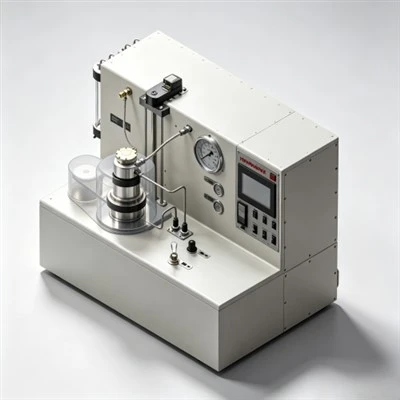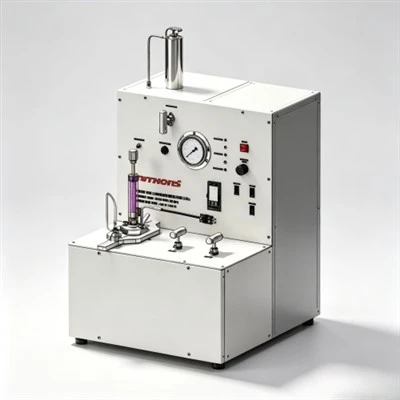

What is cementing in oil field operations and how does it safeguard wellbore integrity? Cementing in oil field engineering is the primary well-construction process of preparing, pumping, and placing a chemically engineered cement slurry into the annular space between a steel casing string and the surrounding geological borehole wall. In subsurface hydrocarbon extraction, cementing establishes a structural, low-permeability hydraulic barrier that isolates permeable oil, gas, and water-bearing formations, anchors heavy casing strings, and shields steel equipment against corrosive downhole fluids. When drilling engineers evaluate what cementing in oil field operations achieves, they analyze fluid displacement efficiency, compressive strength development, static gel strength transition, and long-term chemical resistance. Successfully executing oil field cementing ensures zonal isolation, prevents toxic fluid migration, and underpins safe reservoir production across the life of the well.
A comprehensive technical analysis of what cementing in oil field environments involves covers chemical slurry formulations, multi-stage annular pumping procedures, rheological flow regimes, rigorous API testing standards, and real-world field completion scenarios.
1. Core Operational Stages: Preparing, Pumping, and Setting Cement Slurries
Understanding what cementing in oil field completions requires involves examining the sequential phase sequence executed on modern drilling rigs. The primary objective is to displace drilling mud completely and replace it with a durable, hydraulic cement sheath.
The primary operational steps of what cementing in oil field jobs entail include:
- Wellbore Conditioning & Pre-Flush Spacers: Prior to slurry injection, chemically optimized spacer fluids and pre-flushes are pumped to scour mud cakes, equalize downhole temperatures, and separate incompatible drilling fluids from the incoming cement slurry.
- Slurry Batch Mixing & Additive Activation: Class A, G, or H Portland cements are blended with freshwater or brine, incorporating specialized chemical additives including retarders, dispersants, fluid loss control agents, and defoamers to tailor fluid rheology.
- Annular Hydraulic Displacement: High-pressure triplex cementing pumps drive the slurry down the interior of the casing string, through the casing shoe, and upward into the annulus under strictly controlled laminar or turbulent flow regimes.
- Static Hydration & Compressive Strength Development: Once positioned, the cement slurry undergoes static hydration under bottomhole temperature and pressure (BHT/BHP), transitioning from a liquid state into a low-permeability crystalline sheath.
Technical Knowledge Extension: To examine fundamental wellbore construction principles and slurry placement dynamics, review our comprehensive analysis on how wellbore cementing works across complex drilling environments.
2. Chemical Additive Matrix: Functions, Operational Limits & Dosages
Formulating slurries to withstand diverse subterranean environments is central to what cementing in oil field engineering demands. Chemical additives alter hydration kinetics, fluid loss rates, and mechanical ductility to ensure long-term wellbore survivability.
The table below outlines performance characteristics for primary chemical additives used when executing what cementing in oil field operations require:
| Chemical Additive Category | Primary Chemical Base | Typical Dosage Range | Primary Operational Objective | Impact on Slurry Properties |
|---|---|---|---|---|
| Cement Retarders | Lignosulfonates / AMPS Copolymers | 0.1% – 1.5% BWOC | Extend slurry pumping thickening time in deep wells. | Delays C₃S hydration; prevents premature gelation during placement. |
| Fluid Loss Control Agents | Modified Cellulosic / Synthetic Polymers | 0.3% – 1.2% BWOC | Prevent water filtration loss into permeable formations. | Forms dynamic filter cake; prevents slurry flash dehydration. |
| Friction Reducers / Dispersants | Polynaphthalene Sulfonate (PNS) | 0.2% – 0.8% BWOC | Reduce apparent viscosity and pumping pressure. | Improves flowability; enables turbulent flow at lower displacement rates. |
| Expanding Additives | Magnesium Oxide / Calcined Zinc Blends | 0.5% – 2.0% BWOC | Eliminate micro-annular gaps due to chemical shrinkage. | Induces controlled post-set volumetric expansion; enhances shear bond strength. |
Technical Knowledge Extension: For a broader review of essential chemical classifications and formulation practices, explore our overview of essential oil well cementing additives and chemical solutions.
3. Critical Functions of the Cement Sheath in Well Isolation
The ultimate success of what cementing in oil field projects deliver rests on three primary mechanical and hydraulic functions that protect the wellbore across decades of production:
- Zonal Hydraulic Isolation: By filling every void across permeable geological strata, set cement prevents high-pressure formation gas, brine, or heavy hydrocarbons from migrating into adjacent water aquifers or leaking to the surface.
- Casing Support & Structural Anchoring: Set cement distributes mechanical stresses, supporting the weight of multi-thousand-meter steel casing strings while protecting against buckling, tectonic shear, and formation collapse.
- Corrosion Protection: Alkaline cement sheaths create a passive protective environment around steel casing, shielding downhole pipe against aggressive hydrogen sulfide (H₂S), carbon dioxide (CO₂), and saline groundwater attack.
- Gas Migration Prevention: Formulated slurries maintain hydrostatic pressure control throughout the critical transition state-when the cement matrix transforms from a liquid to a rigid solid-blocking gas micro-channel formation.
4. Slurry Rheology & Hydration Kinetics Under High-Shear Pumping
Detailed fluid dynamics govern what cementing in oil field execution demands during deep displacement operations. Cement slurries are non-Newtonian Bingham plastic fluids exhibiting yield stress and shear-thinning behavior. During high-rate displacement down the casing, shear rates can surpass 1,200 s⁻¹. Chemical dispersants reduce matrix yield stress, enabling low displacement surface pressure while preserving sufficient structural gel strength under static conditions to hold heavy weighting materials in suspension.
Understanding hydration kinetics is essential when managing what cementing in oil field jobs require under extreme HPHT temperatures. Calcium silicate phases (alite C₃S and belite C₂S) react with water to precipitate calcium silicate hydrate (C-S-H) gel and calcium hydroxide crystals. Advanced synthetic retarders temporarily chelate calcium ions, suppressing premature nucleation and preserving slurry pumpability until full annular placement is achieved.
Technical Knowledge Extension: To study setting time control mechanisms and chemical retarder chemistry, read our technical article on how cementing retarders control hydration in deep oilwells.
Regional Application Case: Middle Eastern High-Pressure/High-Temperature Deep Cementing
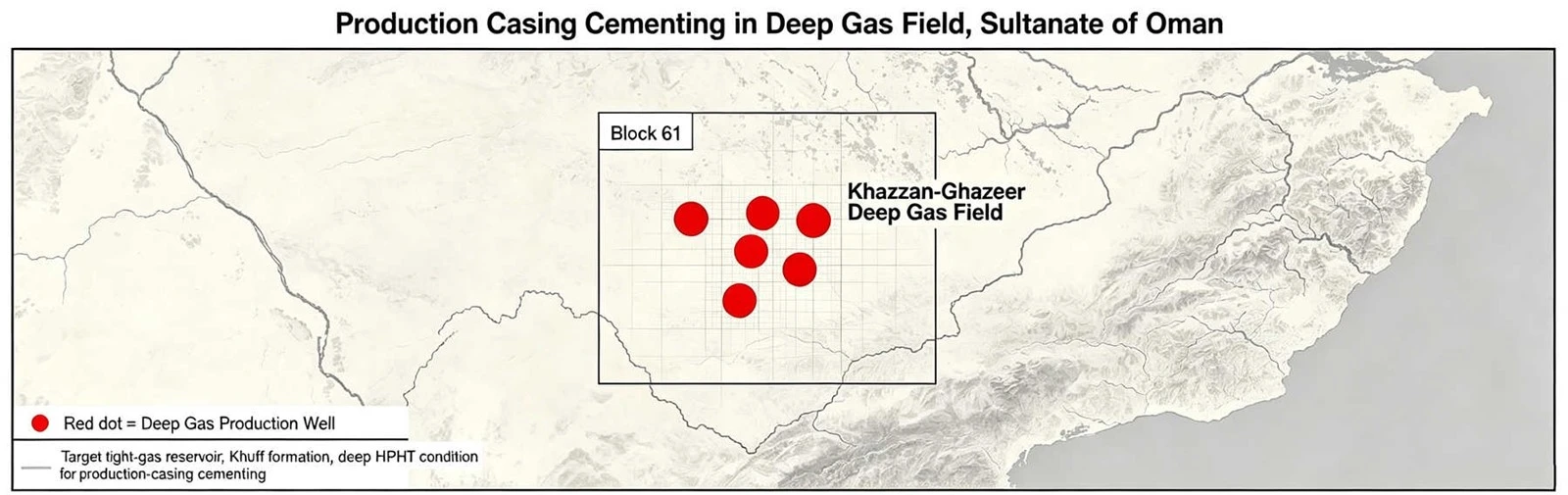
Case Application: Production Casing Cementing in Deep Gas Field, Sultanate of Oman
Regional Cementing Background in Arabian Peninsula Formations
Deep exploration gas wells in onshore Oman target tight carbonate and sandstone reservoirs located below 5,200 meters (17,000 ft). Operators face bottomhole static temperatures exceeding 165°C (329°F) and narrow mud-weight windows between pore pressure and formation fracture gradients.
Regional Operational Challenges in HPHT Wells
High ambient temperatures rapidly accelerate cement hydration, risking flash setting inside casing strings before slurry placement is finished. Furthermore, drilling mud contamination and high differential pressures risk creating micro-annuli, leading to sustained casing pressure (SCP) at the surface.
Technical Requirements for Deep Well Slurry Systems
The operator established strict slurry design parameters for the 7-inch production liner cementing job:
- Predictable thickening time window of 6.5 hours at 165°C and 12,500 psi bottomhole pressure.
- API fluid loss maintained under 35 mL/30 min to prevent slurry bridge formation in narrow annuli.
- Zero free fluid separation and non-settling stability across a 1.95 g/cm³ (16.2 ppg) high-density slurry column.
- Early compressive strength exceeding 2,000 psi within 24 hours to minimize wait-on-cement (WOC) time.
How Engineered Additives Secured Hydraulic Integrity
The engineering team designed a high-density Class H slurry modified with high-temperature AMPS copolymer retarders, synthetic fluid loss control polymers, and expansion additives. High-shear mixing ensured complete chemical activation prior to high-pressure downhole pumping.
Regional Application Case Results
The field completion yielded outstanding operational outcomes:
- Pumping displacement was completed safely with consistent surface pressure profiles.
- Compressive strength reached 2,450 psi in 24 hours, verified by Ultrasonic Cement Analyzer (UCA) monitoring.
- Segmented Bond Logs (SBL) confirmed 100% continuous hydraulic sealing across gas pay zones without micro-annular leaks.
5. Quality Testing Protocols & API Laboratory Standards (API RP 10B-2)
Validating slurry performance under API RP 10B-2 testing standards is mandatory to verify what cementing in oil field designs accomplish prior to field mixing:
Key laboratory evaluation procedures include:
- Pressurized Consistometer Thickening Time: Measures slurry viscosity under simulated bottomhole temperature and pressure schedule, establishing exact pumpability limits in Bearden units (Bc).
- HPHT Filtration Loss Evaluation: Measures liquid filtrate loss through a 325-mesh screen under 1,000 psi differential pressure, evaluating filter cake performance.
- Ultrasonic Cement Analyzer (UCA) Testing: Continuously measures acoustic pulse velocity through setting cement to determine non-destructive compressive strength development over time.
- Shear & Hydraulic Bond Strength Testing: Evaluates shear bond strength at the casing-cement interface and hydraulic bond strength at the formation face to confirm seal integrity under pressure changes.
Frequently Asked Questions (FAQ)
What is cementing in oil field engineering and why is it essential?
Oil field cementing is the pumping of engineered cement slurry into the casing-borehole annulus to create a solid barrier that isolates permeable zones, anchors casing, and prevents unwanted fluid movement.
What is the difference between primary and remedial cementing?
Primary cementing is conducted immediately after running a new casing string to isolate formations. Remedial (squeeze) cementing repairs defective seals, plugs depleted zones, or fixes casing leaks after initial placement.
How do chemical additives improve cement sheath durability downhole?
Additives control slurry viscosity, delay hydration timing, prevent filtration water loss, and cause minor expansion, ensuring complete annular fill and long-term resistant sealing under harsh HPHT environments.
Establishing Durable Well Integrity with Advanced Cementing Technologies
Understanding what cementing in oil field operations require highlights the critical balance between chemical formulation, hydraulic flow control, and rigorous laboratory testing. By pairing high-performance cementing additives with precise wellbore conditioning, drilling operators protect hydrocarbon reserves and establish durable zonal isolation across complex wellbores worldwide.
Optimize Your Oil Well Cementing Formulations Today
We supply high-grade cementing additives, retarders, and fluid loss control agents compliant with API Spec 10A standards for international oilfield completion operations.
Get Technical Pricing for Cementing Additives