



Understanding the fundamental mechanics of fluid loss in cementing is critical for well integrity engineers designing casing primary cementing programs in permeable oil and gas reservoirs. In oilwell completion, fluid loss in cementing refers to the filtration process where the liquid phase (mix water and soluble chemicals) escapes from the cement slurry into porous formation rocks under differential pressure downhole. Uncontrolled fluid loss in cementing leads to rapid slurry dehydration, severe viscosity spikes, flash setting, and premature annular bridging. Furthermore, excessive fluid loss in cementing causes formation damage through filtrate invasion and reduces hydrostatic head, exposing the wellbore to high-pressure gas channeling. Managing fluid loss in cementing according to API Spec 10A standards using specialized polymer fluid loss additives is essential to maintain slurry rheology, protect reservoir permeability, and guarantee long-term zonal isolation across deep production intervals.
Examining the physical filter cake mechanisms and downhole impacts reveals why precise filtration control is mandatory for safe field operations.
1. Physical Mechanisms of Filtration and Filter Cake Formation
The operational process driving fluid loss in cementing begins as soon as the cement slurry contacts porous, permeable reservoir formations under hydrostatic and displacement pressures.
Key physical stages governing fluid loss in cementing phenomena include:
- Differential Pressure Driving Force: The total pressure gradient (hydrostatic pressure plus circulating friction minus formation pore pressure) forces mix water into permeable pore throats.
- Initial Spurt Loss Phase: Before a protective filter cake establishes, a brief burst of unhindered filtrate enters the formation face.
- Deposition of Filter Cake: Suspended cement particles, micro-silica, and solid additives stack upon the wellbore face, forming a low-permeability cake matrix.
- Equilibrium Filtration Rate: As the filter cake thickness increases, the rate of fluid loss in cementing slows to a steady-state logarithmic filtration rate.
Related Technical Reading: Discover chemical formulations used to control filtration in Understanding Fluid Loss Additives for Oilwell Cementing Operations.
2. Operational Risks of Uncontrolled Slurry Dehydration
Failing to regulate fluid loss in cementing triggers severe chemical and mechanical operational hazards that jeopardize the entire well construction campaign.
A technical matrix detailing the primary engineering risks of unmitigated fluid loss in cementing is summarized below:
| Engineering Risk | Physical Mechanism | Downhole Operational Impact | API Control Benchmark |
|---|---|---|---|
| Slurry Dehydration & Bridging | Excessive water loss increases solid concentration rapidly. | Viscosity spikes cause pump pressure surges, leading to premature job node bridging and stuck casing. | Maintain API filtration below 50 mL/30 min. |
| Gas Channeling Invasion | Loss of aqueous volume reduces hydrostatic pressure head below pore pressure. | Formation gas migrates through static cement matrix during transition phase, causing sustained casing pressure. | Target API filtration below 30 mL/30 min for gas wells. |
| Reservoir Permeability Damage | Chemical filtrate and fine particles invade hydrocarbon pore throats. | Clay swelling and emulsion blocking reduce near-wellbore oil and gas productivity. | Use non-damaging polymer additives. |
| Impaired Cement Bond Quality | Incomplete displacement of drilling fluid due to localized slurry thickening. | Poor acoustic bond logs (CBL/VDL) requiring expensive remedial squeeze operations. | Maintain constant plastic viscosity. |
Strict control over fluid loss in cementing eliminates these structural hazards, protecting both wellbore integrity and hydrocarbon production capacity.
Related Technical Reading: Learn how to optimize chemical dosage for varying temperature profiles in Selection and Performance Optimization of Cementing Fluid Loss Additives.
3. Chemical Additive Solutions and API Standard Testing
Mitigating fluid loss in cementing relies on incorporating high-performance synthetic polymers and particulate additives into slurry formulations.
Key additive mechanisms used to combat fluid loss in cementing include:
- Water-Soluble Polymers (AMPS / PAM Co-polymers): High-molecular-weight polymers increase filtrate viscosity and adsorb onto cement grains, plugging filter cake channels.
- Latex Emulsions: Flexible latex polymer particles deform under pressure to form an impermeable micro-film across the filter cake face.
- Particulate Bridging Agents: Fine silica flour and bentonite particles block pores within the developing filter cake matrix.
- API High-Temperature High-Pressure (HTHP) Testing: Evaluated using standard filter presses at 1,000 psi (6.9 MPa) differential pressure across a 325-mesh screen.
Related Technical Reading: Explore how filtration control fits into the broader primary cementing workflow in Comprehensive Technical Guide: What is Cementing a Well?.
Regional Application Case: Sulige High-Permeability Sandstone Gas Field, Ordos Basin, China
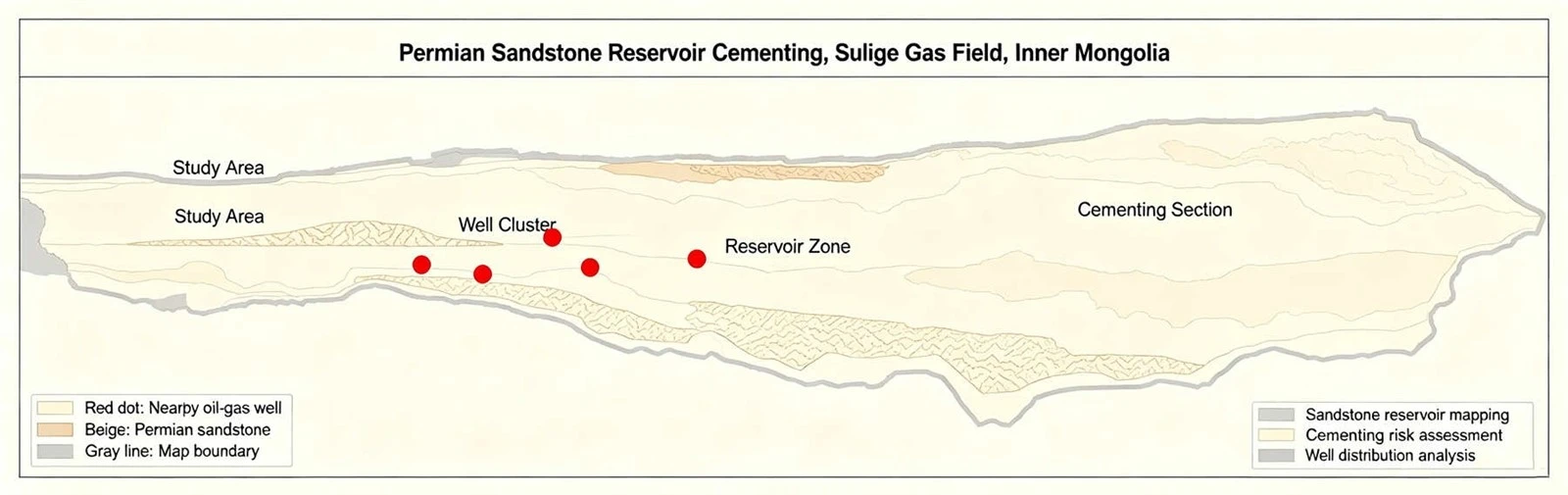
Case Application: Permian Sandstone Reservoir Cementing, Sulige Gas Field, Inner Mongolia
Regional Cementing Background in Sulige Field
The Sulige Gas Field in the Ordos Basin features extensive tight and medium-permeability Permian sandstone gas reservoirs (permeability ranging from 0.1 to 15 mD). Deep horizontal gas wells require primary cementing across long permeable intervals to ensure zonal isolation between tight gas sands and water-bearing zones.
Regional Operational Challenges with Slurry Filtration
During initial development campaigns, standard cement slurries exhibited high filtration rates exceeding 250 mL/30 min. High differential pressures caused severe fluid loss in cementing, resulting in rapid slurry dehydration, high ECD surging, bridging in narrow annulus sections, and widespread gas channeling behind casing.
Technical Requirements for Low-Filtration Slurry Design
To eliminate annular gas migration and ensure full displacement, field operators established rigid limits for controlling fluid loss in cementing:
- API HTHP fluid loss controlled below 35 mL/30 min at bottomhole temperatures of 110°C.
- Zero viscosity build-up or flash setting during 6-hour slurry placement schedules.
- Formation damage protection to prevent mud filtrate clay swelling in sensitive sandstone pores.
How Synthetic Fluid Loss Polymers Solved Field Dehydration
Engineers integrated an AMPS-based synthetic polymer fluid loss additive combined with a latex micro-emulsion. This combination provided double-action control: the AMPS polymer increased filtrate viscosity while latex particles sealed micro-pores in the filter cake, successfully restricting fluid loss in cementing to 28 mL/30 min.
Regional Application Case Results
Deploying slurries optimized for low fluid loss in cementing achieved outstanding field results across 22 horizontal gas wells:
- Achieved 100% successful cement slurry placement without a single annular bridging incident.
- Completely eliminated sustained casing pressure (SCP) caused by early gas channeling.
- Improved acoustic bonding ratings (CBL/VDL) to over 92% high-quality bond across gas production target horizons.
4. Best Practices for Controlling Filtration in Field Operations
Maintaining effective management of fluid loss in cementing requires disciplined slurry pre-testing and batch mixing procedures at field locations.
Recommended quality control measures for limiting fluid loss in cementing include:
- Mix Water Quality Verification: Test water salinity and hardness prior to batch mixing, as high calcium or salt levels can inhibit synthetic polymer hydration.
- Shear History Matching: Ensure laboratory test blending mirrors field batch mixer shear rates to guarantee identical polymer activation.
- Pre-Job HTHP Press Testing: Conduct full API fluid loss tests on location using actual job mix water and cement samples prior to pumping.
- Density and Rheology Monitoring: Continuously monitor slurry density with pressurized mud balances to detect early signs of localized dehydration.
Frequently Asked Questions (FAQ)
What is the standard API target for fluid loss in cementing gas wells?
For critical gas wells with high gas channeling potential, API recommended practice targets an HTHP fluid loss of less than 30 to 50 mL/30 min measured at 1,000 psi differential pressure.
How does fluid loss in cementing cause casing bridging during pumping?
When slurry loses water to permeable formations, the solid volume fraction increases. This rapid thickening increases slurry yield point, leading to localized mechanical plugging or bridging in narrow annular spaces.
What is the difference between static and dynamic fluid loss in cementing?
Static fluid loss occurs when the cement slurry is motionless during static gelation or holding periods, whereas dynamic fluid loss occurs while the slurry is actively being pumped and circulated past permeable formations.
Can temperature impair the performance of polymer fluid loss additives?
Yes, excessive thermal stress can degrade basic cellulose polymers. High-temperature wells require synthetic AMPS-based co-polymers rated for stability above 150°C (300°F).
Protecting Wellbore Integrity Through Precise Filtration Control
Effective control of fluid loss in cementing represents a cornerstone of modern oilwell construction technology. By understanding filtration mechanics, applying high-performance chemical fluid loss additives, and conducting rigorous API field testing, petroleum operators ensure smooth slurry displacement, prevent gas migration, and achieve superior long-term zonal isolation.
Optimize Your Cementing Slurries with Advanced Fluid Loss Additives
We supply high-performance AMPS synthetic polymers and latex fluid loss additives designed for low API filtration, thermal stability, and superior gas channeling control.
Explore Our Cement Additives PortfolioOptimizing Field Operations with Standardized Testing and Engineering Support
Achieving long-term zonal isolation and maintaining wellbore structural integrity requires a rigorous, data-driven understanding of both chemical additive performance and downhole physical simulation. As global drilling operations push deeper into high-pressure, high-temperature (HPHT) zones, ultra-deepwater plays, and unconventional tight gas formations, standard cement formulations can no longer guarantee success without precise optimization. Whether evaluating slurry thickening time profiles, controlling precise fluid loss, or monitoring early compressive strength build-up, petroleum engineers must rigorously align laboratory protocols with the latest API RP 10B-2 and ISO 10426 industry standards.
Standardized laboratory testing equipment plays a crucial role in bridging the gap between benchtop experiments and actual rig site execution. Utilizing automated consistometers, high-pressure filtration cells, and non-destructive ultrasonic cement analyzers (UCA) provides real-time, repeatable data that directly influences field pumping schedules. Integrating advanced chemical additives-such as thermally stable polymers, organic retarders, and targeted dispersants-with high-precision laboratory verification minimizes operational hazards, eliminates fluid migration risks, and prevents costly casing failures or sustained casing pressure (SCP).
Ultimately, holistic slurry design and strict quality assurance protocols significantly shorten wait-on-cement (WOC) time, allowing operators to transition safely to subsequent drilling or hydraulic fracturing stages. By combining state-of-the-art laboratory testing equipment with customized additive packages, oilfield service companies can maximize operational safety, reduce non-productive time (NPT), and optimize the overall economic performance of oil and gas assets throughout their operational lifecycle.
Need Customized Cementing Equipment or Chemical Testing Solutions?
Our technical engineering team provides high-precision laboratory testing instruments and tailored slurry additive formulations to meet your demanding field requirements worldwide. Contact our specialists today to enhance your cementing performance and wellbore stability.
Contact Our Technical Experts


